Seed Cycling and the Hormonal Rhythm: A Holistic Approach to Women’s Endocrine Health
For generations, women have grown up without meaningful education about their hormonal health. Most are never taught how their endocrine system works, or why supporting it proactively is essential for lifelong well-being. Instead, many only encounter the conversation once they are already struggling with painful periods, irregular cycles, infertility, or chronic hormonal symptoms.
This lack of early education has real consequences. Hormones are not “extra” or secondary features of the body — they are central regulators of nearly every physiological process. Research shows that the female endocrine system influences energy metabolism, mood regulation, fertility, immune function, digestion, sleep, skin integrity, and cognitive health (Hillard, 2014; Stuenkel et al., 2015). When hormone rhythms fall out of balance, the entire body feels the effects.
Understanding the Female Hormonal Rhythm
The average woman experiences a 28-day menstrual cycle, consisting of four key phases: follicular, ovulatory, luteal, and menstrual. Each stage is governed by predictable shifts in estrogen, progesterone, follicle-stimulating hormone (FSH), and luteinizing hormone (LH). Studies show that maintaining this natural hormonal rhythm is critical for metabolic stability, reproductive health, emotional regulation, and endocrine balance (Alvergne & Lummaa, 2010).
Yet many women are unaware of these phases, how they feel in the body, and how lifestyle or nutrition can support them. Without this awareness, even mild hormonal imbalances may progress into more complex health concerns.
Hormonal Imbalance and Modern Women’s Health Conditions
A growing body of literature links disruptions in the endocrine system to many conditions commonly affecting women today. These include:
Polycystic ovary syndrome (PCOS)
Endometriosis
Amenorrhea and irregular cycles
Premenstrual syndrome (PMS) and PMDD
Fibroids
Infertility
Perimenopause and menopausal symptoms
Acne and skin conditions
Unexplained fatigue and weight fluctuations
Research confirms that hormonal dysregulation, inflammation, and impaired ovulatory patterns play major roles in these disorders (Gibson-Helm et al., 2018; Zondervan et al., 2018). Importantly, these conditions do not arise because women’s bodies are “broken.” Rather, they often emerge because women have not been taught how to identify or support hormonal imbalance early.
What Is Seed Cycling?
Seed cycling is a nutritional strategy used in functional and integrative medicine to support the natural phases of the menstrual cycle. The practice is grounded in research about the nutritional components of seeds and their influence on hormones.
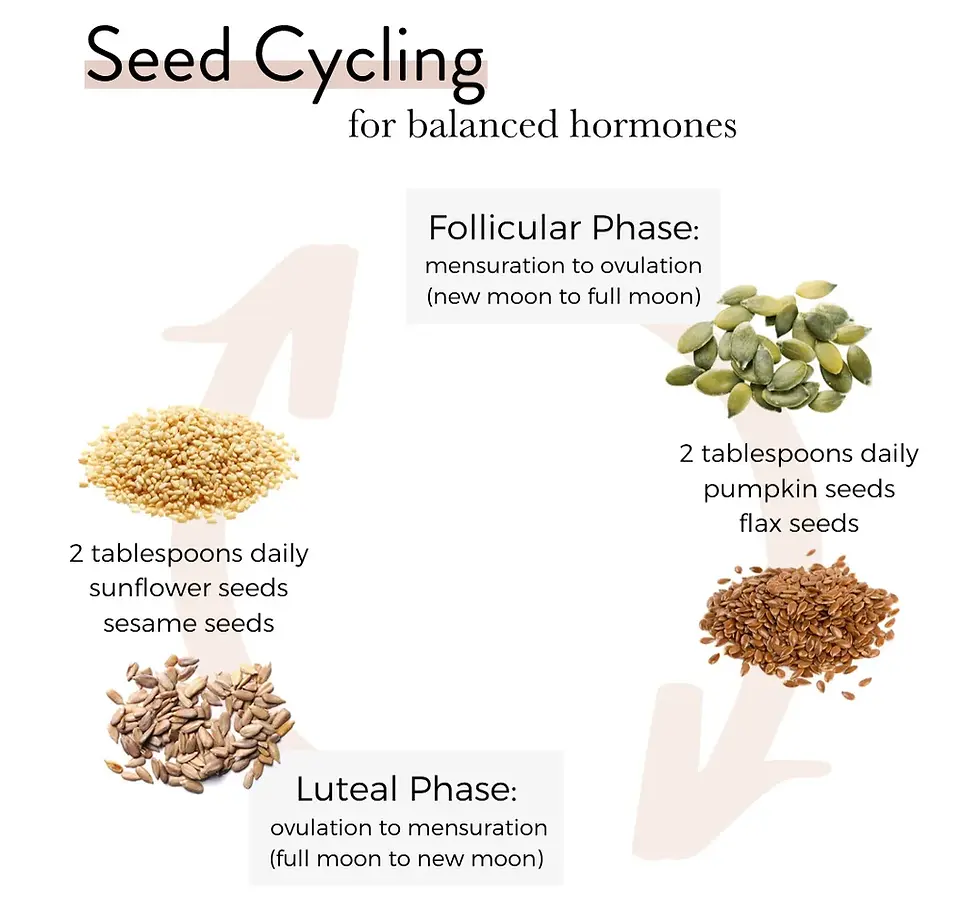
Typically, it involves rotating specific seeds throughout the menstrual cycle:
Follicular Phase (Days 1–14):Flax seeds and pumpkin seeds — rich in lignans and zinc, which may support healthy estrogen metabolism and ovarian function.
Luteal Phase (Days 15–28):Sesame seeds and sunflower seeds — high in vitamin E, selenium, and lignans that may assist in progesterone balance and inflammation modulation.
Studies show that lignans from flax and sesame can positively influence estrogen levels by modulating its metabolism and binding pathways (Adlercreutz et al., 1992; Thompson et al., 1991). Zinc, magnesium, vitamin E, and essential fatty acids also play documented roles in hormone synthesis and stabilization (Taneja, 2014; Wong et al., 2017).
Why Supporting the Cycle Matters
When the hormonal rhythm is disrupted — whether from stress, nutrient deficiencies, endocrine disruptors, chronic inflammation, or metabolic imbalance — women may begin experiencing systemic symptoms. Hormones are deeply interconnected, and when one shifts, the others often follow.
Supporting the menstrual cycle with targeted nutrition, stress management, regular ovulation, and cycle awareness can improve hormonal regularity. Studies show that diet and lifestyle strategies can significantly influence endocrine balance, inflammatory pathways, and menstrual health (Fung et al., 2018; Chavarro et al., 2007).
Seed Cycling as a Gentle Hormone-Support Tool
Seed cycling is a simple, accessible, and holistic approach that encourages women to reconnect with their biology and support their cycle rather than fight it. By aligning nutrition with the natural fluctuations of estrogen and progesterone, it provides the body with essential micronutrients that assist hormonal regulation.
It is not a cure-all — but it is a powerful starting point.
For many women, seed cycling becomes the first step in understanding their hormonal patterns, identifying imbalances, and supporting the body through each phase of the cycle. Combined with good nutrition, stress management, sleep, and a toxin-conscious lifestyle, it can contribute to meaningful improvements in menstrual and hormonal health.
Conclusion
Women deserve education about their endocrine system long before symptoms develop. Hormones influence every facet of health, and learning to support the menstrual cycle is foundational for lifelong wellness. Seed cycling is one gentle, natural tool that helps restore hormonal harmony and empowers women to take an active role in their health.
References
Adlercreutz, H., et al. (1992). Lignans and phytoestrogens: Possible role in cancer prevention. Cancer Causes & Control, 3(3), 211–220.
Alvergne, A., & Lummaa, V. (2010). Ecological variation in female reproductive physiology. Behavioral Ecology, 21(4), 784-791.
Chavarro, J. E., et al. (2007). Dietary fat intake and the risk of ovulatory infertility. American Journal of Clinical Nutrition, 85(1), 231-237.
Fung, J., et al. (2018). Nutrition and menstrual health: A review. Journal of Obstetrics and Gynaecology Canada, 40(5), 1-11.
Gibson-Helm, M., et al. (2018). Women’s experiences of PCOS diagnosis: A systematic review. Women’s Health, 14, 1–14.
Hillard, P. (2014). Hormonal regulation of the menstrual cycle. Obstetrics & Gynecology Clinics, 41(1), 1–16.
Stuenkel, C. A., et al. (2015). Treatment of symptoms of the menopause. The Journal of Clinical Endocrinology & Metabolism, 100(11), 3975–4011.
Taneja, S. (2014). Micronutrients and hormonal balance. Nutrition Research Reviews, 27(2), 1–12.
Thompson, L. U., et al. (1991). Dietary flaxseed alters estrogen metabolism. Cancer Letters, 60(2), 135–142.
Wong, L. P., et al. (2017). Zinc and female reproductive health. Reproductive Biology, 17(4), 1–10.
Zondervan, K. T., et al. (2018). Endometriosis. Nature Reviews Disease Primers, 4, 9.


Comments